Thursday, 24 March 2016

Phil Fisher's Common Stocks and Uncommon Profits Review and Notes

Charlie Munger said he 'always likes it when someone attractive to me agrees with me' when asked his view on Phil Fisher. I don't believe Fisher's views on investing instigated Munger's multidisciplinary model approach but both of their views on investing in quality businesses are sure aligned. 

Fisher follows a thorough bottom-up research process and believes in knowing any investment you have better than others. He chases previous employers, contacts suppliers and evaluates every product line of every firm that passes his initial investment checklist. He is a growth investor, but not in the modern day meaning of buying factor-based momentum stocks. A business analyst not a financial analyst. 

Fisher writes in a clear, succinct manner shedding great insight into how to research companies independently. He provides a clear 15 point checklist of what to look for in high-quality, growth stocks that is useful as a checklist before any long term investment:

1. Does the company have products or services with sufficient market potential to make possible a sizable increase in sales for at least several years? A company seeking a sustained period of spectacular growth must have products that address large and expanding markets. 

2. Does the management have a determination to continue to develop products or processes that will still further increase total sales potentials when the growth potentials of currently attractive product lines have largely been exploited? 

3. How effective are the company's research-and-development efforts in relation to its size? 

4. Does the company have an above-average sales organization? Expert merchandising needed to exceed sales targets.

5. Does the company have a worthwhile profit margin? 

6. What is the company doing to maintain or improve profit margins?  "It is not the profit margin of the past but those of the future that are basically important to the investor." 

7. Does the company have outstanding labor and personnel relations? Happy employees, higher productivity. 

8. Does the company have outstanding executive relations? Just as having good employee relations is important, a company must also cultivate the right atmosphere in its executive suite. Pay attention to incentives.

9. Does the company have depth to its management? Fisher warned investors to avoid companies where top management is reluctant to delegate significant authority to lower-level managers. 

10. How good are the company's cost analysis and accounting controls? 

11. Are there other aspects of the business, somewhat peculiar to the industry involved, which will give the investor important clues as to how outstanding the company may be in relation to its competition? Understand determining factors for different industries. 

12. Does the company have a short-range or long-range outlook in regard to profits? Fisher argued that investors should take a long-range view, and thus should favor companies that take a long-range view on profits. 

13. In the foreseeable future will the growth of the company require sufficient equity financing so that the larger number of shares then outstanding will largely cancel the existing stockholders' benefit from this anticipated growth? 

14. Does management talk freely to investors about its affairs when things are going well but "clam up" when troubles and disappointments occur? 

15. Does the company have a management of unquestionable integrity? 

Full notes to the book are here

Thursday, 25 February 2016

Global Trade and the Prisoner's Dilemma Game


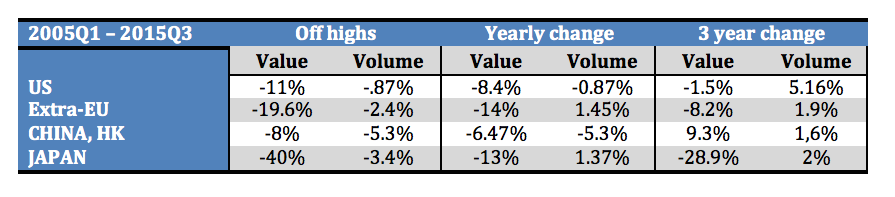
 Global trade volume is decreasing. Export volumes seem to have peaked, not just in one economy, globally, towards the end of 2014.  Although the declines are not as large as those in 2008, a huge 18% peak to trough globally, the widespread pressure on exports is weighing down growth and instigates the type of crazy monetary policy we have seen lately.

Extra-EU trade volume, trade exported outside Europe, has increased 1.5% over the last three years.  However, the value of this volume is 8% lower due to the real EU effective exchange rate falling 5.2% in the same period. Global trade is structurally challenged. How vital are exports to economies?


Central banks seem to be in a huge game of prisoner’s dilemma. Central banks worldwide are competing to maintain domestic growth and they are doing ‘whatever it takes’ to achieve it. They are all in a situation where if they do not devalue their currency, defecting in the prisoner’s dilemma, and expand policy, other central banks will do so and therefore they will lose the game. However, now it seems we are in a situation whereby all central banks are easing and devaluing, prisoners are defecting, and global output is therefore structurally lower; all payoffs for players are lower.

And once you leave the Nash equilibrium, it is not easy to get back there!


Thursday, 18 February 2016

Are the hedge funds shorting London Property market wrong?

Berkeley Group Holdings recently fell around 15% after a few hedge funds shorted the London housing market in the midst of panic. The funds believe there are pockets of oversupply in London and pressure from emerging market demand that will cause a supply-demand imbalance. The FT also recently released news that the price per square foot for prime London property dropped from £1,839 to £1,813 last year, indicating signs of a reverse of the excess demand in the market we have seen.

Are these macro funds playing on recent macroeconomic developments such as the effects of falling oil prices on emerging, most probably Russian and Chinese, demand for London property and FX devaluations? These short sellers led me to check some numbers to test the potential damage to Berkeley.  

The two driving factors in any homebuilders’ margins are the cost of land and final sales price.

Figure 1 shows the average selling price was £575k in 2015, up from £280k in 2012. This is huge and unsustainable growth in prices. BKG also mention 2015 average selling price was driven by sales mix at the very top end of the market.

Land costs as a percentage of final selling price peaked in 2014 at 17.3% and is 15.2% on average over the last 5 years. 
Figure 2 shows the upward trend of land cost in absolute values. The average value of land between 2012-15 was £66,000. This is nearly double the average over the previous 8 years. This is mainly because in 2013 and 2014 they purchased 5,500 plots of land in London for on average £121,000. These were all in prime spots, Canary Wharf, Dockland’s Wimbledon etc. I believe these are the purchases the hedge funds believe are bought near the top of the cycle and, therefore, will depress earnings.  However, this represents only a small portion of the land held by BKG.


Figure 3 above shows the growth in plots in BKG land bank which can be misleading. The huge jump of around 10,000 plots in 2015 is due to the long-term options they purchase through time finally being approved for development. These are plots of land that are bought years earlier, at cheap brownfield prices, and are now ready to begin development. This is where BKG earn their superior margins.

So how much damage can the £600m purchase of land at, potentially, the top of the cycle do to future earnings? We don’t get the margins for individual projects although we can make some rough estimates. Figure 4 below shows the average price for new dwellings fell max 15% and 9% in London and the South East respectively during the financial crisis.

Rightmove show the average current prices of Greater London to be around £610,000 and at the top end, which Berkeley certainly will be supplying with the £600m of acquisitions, £1.5m.


If we assume one plot is minimum one home. This means the most recent acquisitions of £121,000 per plot in Greater London were the land cost for each home. At a 33% discount to the average price in London, the selling price would be £400,000 for these plots. This gives them plenty of room to not actually destroy value with this purchase even in worse case scenario.

Can these external macro factors really disrupt Berkeley’s fundamentals?

Demand

BKG look to sell houses forward to reduce risk. They currently have around £3bn of forward sales due in the next 3 years under UNCONDITIONAL contracts. These forward sales increased by £685m from 2014 to 2015, an increase of 30.1%. Forward sales have a CAGR of 29% over the last 5 years. Customers are increasingly buying homes from Berkeley before they are even built. Berkeley currently holds £920m from deposits on these forward sales, around 30% deposit rate.

Berkeley’s customers include housing associations, providers of student accommodation, investors and first-time buyers. In 2014 BKG opened international offices in Dubai and Beijing because over the five years to 2014 £1.2bn in sales had come from overseas. After all, BKG have got properties available in London for up to £23m!!

The Residential Institute for Chartered Surveyors residential market survey provides a good indicator of the industry supply and demand balances. The February 2016 release concludes:

  • London has seen an uptick in new sales listings in the last few months.
  • New buyer enquiries rose for 10-month. Demand is being bolstered by buy-to –let investors before the 3% surcharge policy in April.
  • 50% of surveyors also believe this charge will cause a slowdown in investment after the surcharge.
  • Excess demand oversupply persists, prices remain firmly in up-trend. 72% more surveyors believe prices will continue this trend.
  • 65% of surveyors believe London and South East is above fair value to some extent. However, this number has not changed in 6 months.
  • South East region is increasingly under-supplied.

This survey provides great insight into real industry trends and developments. The April 3% Stamp Duty surcharge for buy-to-let will cause rapid demand in Q1 which will likely fall thereafter. Prices will lag and, therefore, I believe that towards the end of 2016 we could see a larger slowdown in prices in London (which will then encourage first-time buyers who seem to be waiting).

This survey provides great insight into real industry trends and developments. The April 3% Stamp Duty surcharge for buy-to-let will cause rapid demand in Q1 which will likely fall thereafter. Prices will lag and, therefore, I believe that towards the end of 2016 we could see a larger slowdown in prices in London (which will then encourage first-time buyers who seem to be waiting).

It’s clear that Britain needs more homes to meet rising demographics and population growth in the long term. In 2010, and later extended in 2014, the government set a target to build 1m homes on brownfield sites by 2020 in total. There is plenty of support from the government helping Berkeley build the houses on brownfield land although they are still well below target building only 176,000 total in 2015. The ONS also estimate there is around 2800 and 6000 hectares of brownfield land available for dwellings in London and the South East respectively. 

On the whole, I feel the macro funds are making a bold bet against the fundamentals of the housing market. Also, I think there is a slight chance this was a very short-term trade from the hedge funds to take advantage of short-term panic. There are definitely pockets of fair-overvalued properties in London and even recent scares of oversupply. However, I feel there is still a huge fundamental imbalance of demand and supply that persists and, unless there is a recession precipitated by some kind of China hard-landing, Berkeley should be somewhat protected. I will be keeping a close eye on the RICS report in 2016.


Valuation

Simply discounting the £2 dividends you’re almost certain to receive annually at a cap range of 8-10% gives around £5 NPV today. Last year EPS was £3.13, assuming this does not grow in 3 years and using a multiple of 10 gives £35 as a back of the envelope value.

Book value is £1.76bn and priced at 2.4x. Very pricey relative to comparables, although not when you consider the assets booked at cost.  BKG has 38,000 plots of land booked as cost on their balance sheet. This equates to £5.15bn in future gross margin at an average selling price of £456,000.  At a price of £400,000 this equates to £4.56bn, roughly their market cap today. I will take the option that the average selling price will be above £400,000 and Berkeley management will continue to be purchase cheap brownfield land in the future.

Wednesday, 27 January 2016

Robert Cialdini - Influence Book Review and Notes

I recently read Robert Cialdini's 'Influence - the psychology of persuasion' as the first leg of my '1 non-investment book a month' challenge.

For me, this book is up there with Kahneman's 'Thinking fast and slow'. It's excellent in every way. The author sets out to explain the factors that influence us in all different types of decisions we make. He mixes everyday decisions, historic events and includes readers' letters to explain each 'weapon of influence' that humans are under. 

Why do we feel the need to give back to those who give to us? How do social systems influence decision making? 

Why do we struggle with perception and perspective? 

How powerful is social proof? Why do investors 'follow the herd'?

How does your measure of utility value correlate with availability of the product? 

The author covers a wide range of biases we face in decision making, both complex and basic. As always, there are many strong links from psychological tendencies to decision making within investment that provide a different insight into cognitive biases. 

I can imagine the book worked wonders for salesman or marketers, but also sets a nice foundation for everyone to make better decisions. No wonder it is one of Charlie Munger's favourite books!

I have attached my brief notes here.

Sunday, 17 January 2016

New Year links

I have made a list of some articles I read during my holiday over the New Year that I found particularly interesting covering all topics:

Buffett lessons from 2014 letter - http://www.safalniveshak.com/lessons-from-warren-buffett-2014-letter-to-shareholders/

Farnam Street - Why was Darwin an effective thinker? - https://www.farnamstreetblog.com/2016/01/charles-darwin-thinker/

Great write up of Middle East geopolitical situations - http://www.vox.com/2016/1/4/10708682/sunni-shia-iran-saudi-arabia-war

Great talk between Kahneman and Taleb on Anti-fragility - https://www.youtube.com/watch?v=MMBclvY_EMA&feature=youtu.be

Amazon and cash flow - Anything by Ben Evans on technology is worth reading - http://ben-evans.com/benedictevans/2014/9/4/why-amazon-has-no-profits-and-why-it-works

Howard Mark's recent memo - https://www.oaktreecapital.com/insights/howard-marks-memos

Investment noise and how to deal with it -http://www.forbes.com/sites/rickferri/2013/09/18/2773/#2715e4857a0b53b641e7487b

Manuel of ideas top 10 interviews - http://www.manualofideas.com/wp-content/uploads/2015/12/the-manual-of-ideas-top-ten-interviews.pdf

Hussman - the next big short - http://hussmanfunds.com/wmc/wmc160104.htm

Striving for Rationality: Cialdini, Kahneman and Howard Marks

I recently read Kahneman's 'Thinking Fast and Slow' (again) and Robert Cialdini's 'Influence' for the first time on holiday over the new year. I have alway been fascinated by how the brain works and how to understand decision making.

Thinking about thinking > thinking.

After all, a workman has to understand his tools and an investor's greatest tool is that of his brain. Failing to understanding how your brain works and the influences you face in decision making puts you at a serious disadvantage to others that do.

These two books, Marks' memo and a recent investment I made in TGS towards the end of 2015 has led to this post.

It seems reading these books couldn't have come at a better time with the recent performance of all risk assets in the past month. All I see is negative articles, red tickers and panic. Also coincidentally, Howard Marks writes a memo on just the subject here. I've listed a few quotes below from the piece:

As Ben Graham pointed out, the day-to-day market isn’t a fundamental analyst; it’s a barometer of investor sentiment.

One of the most significant factors keeping investors from reaching appropriate conclusions is their tendency to assess the world with emotionalism rather than objectivity.  Their failings take two primary forms: selective perception and skewed interpretation

If I could know only one thing about an investment I’m contemplating, it might be how much optimism is embodied in the price.

One could argue psychological traits and certain temperaments are more important than financial acumen, as realistically, most people can pick up accounting or financial books and learn.

Selective perception and skewed interpretation refer to the biases of perceiving info in the way we wish that reinforces our own view and only forming unbalanced views.

Kahneman refers to selective perception as confirmation bias. We naturally look for views that reinforce rather than oppose our own.

Cialdini highlights the power of social proof in influencing decision making. In times of uncertainty we look to others to guide decisions, sometimes this means the market itself. Herding and panic then follows.

Investor psychology and market sentiment are factors joined at the hip and an understanding seems crucial to success. "Be greedy when others are fearful" and all that...

I find myself going through a mental process before securities I find that are undervalued:

  • IV < price significantly, so I buy right? 
  • How much more undervalued can this get? 
  • Wait, stick to the process. Do not attempt to time. Move cautiously. 
  • Oh, shock, too early

My recent investment in TGS led me to delve deeper into weighing sentiment into decisions. TGS, a company I analysed here, is down around 25% from my entry after nosediving last week's Q4 update. Obviously it is too early to evaluate whether the investment itself was a mistake, although I sure could have got a better price if I had realised some basic psychological tendencies I was facing during the decision:

Overconfidence and confirmation bias - Kahneman explains how we are overconfident in our own views and we underestimate factors that are outside our control entirely. I became overconfident in my estimate of IV (having collected years of data and hours of research) and underestimated the power of external factors, oil prices and investor sentiment around oil.

I do not try to predict oil prices or time markets, although I feel I made a significant mistake in understanding investor sentiment. I misunderstood the power and length of trends. They last longer than we believe/want and the downside risk was much higher than upside potential in short-term in this instance. Although being disciplined and sticking to the process is crucial, I believe my original process has underweighted sentiment. Checklist updating...

What I really find fascinating about psychological concepts of investment is that I feel I have a fairly good grasp of some biases I am under during decisions but yet I seem to always underestimate the power of some tendencies. Learning from mistakes and carefully going through the psychological aspects of every decision will help in the road to rationalism.

Monday, 21 December 2015

TGS NOPEC: Long term value opportunity

Would you believe me if I told you there's a company that has a 10 year average ROIC and ROE of 32% and 25% respectively, has their customers pay around 50% of capital expenditures and has pricing power over these customers? 

Because this is a long post, quick summary:

  • Negative sentiment around oil has created an opportunity in a well managed, asset-light oil service business.
  • Company allocates capital counter-cyclically, similar to Berkeley Group which I have spoke about here and here
  • Enjoys significant pricing power, high ROIC and operating margins consistently 35-40%

TGS NOPEC is a Norwegian oil and gas service company that provides multi-client seismic data. The 2008 annual report briefly explains the business:


Seismic data is the only rigorous way to physically map sub-surface geology in order to determine where to drill for oil and gas. Oil companies can obtain seismic data either by hiring a seismic contractor and paying the full cost and profit to the contractor, or by purchasing a license to use multi-client data already acquired by a contractor.

So there are two main business models in the industry where E&P companies can either pay full cost for the entire survey and own the data on a propriety basis, or go the cheaper route and pay a fraction of cost and let the seismic company own the data and license it on a non-exclusive basis. 

TGS follow the Multi-Client (MC) model entirely.


This business particularly caught my eye as it has one attribute that is vital to sustaining a competitive advantage: low cost/expense relative to the customers overall cost base. Seismic data firms have pricing power as they save costs in dollar terms and in time for E&P companies. A quote from a competitor, Pulse Seismic, claims that the price of the survey is around 1% the total cost for E&P firms.

Also, Buffett tried to buy a similar firm in 2004, called Seitel, in which he claimed the market undervalued the MC library asset. Anything Buffett looks at is surely worth a look!


TGS Business Model

TGS claimed in their 2008 annual report that they are 'doing things differently' from competitors and following the MC model entirely giving them a very asset light business. Throughout the cycle this allows them to scale back operating expenses facing falling demand and easily meet higher demand by hiring vessels and crew to collect the data. Once this data is collected and owned, the marginal cost of selling this is near zero. 

Before TGS embarks on a project, it gets 'pre-funded' by a group of customers who wish to use the data and TGS themselves. This is normally funded half and half. Making your customer pay for a product you then license back to them seems like a good business to me. 

TGS's main competitors PG and CGG have a combination of the two business models stated above and therefore their balance sheets limits the returns on capital possible:


2014 Numbers ($) 
TGS
CGG
Pet Geo
MC Library
818
947
695
PPE
42
1,238
1,663
Total Assets
1767
7,061
3,563
Debt
0
2,778
2,400
Equity
1339
2,693
1,901


However, there have been a couple of other entrants following TGS's model such as Spectrum ASA, set up by a former TGS guy, and Pulse Seismic. I will come onto barriers to entry later. 


Do the numbers prove TGS'S model has an advantage over their competitors? 


TGS share price performance seemed to decouple from the industry in the last few years as the oil price has nose-dived and their ROIC has been consistently higher for last 10 years.

So what are the factors that enable TGS to maintain these higher numbers?


  • Pricing power – the company serves hundreds of customers. All E&P firms need access to seismic data before they begin operations and it is crucial to saving costs, working efficiently and maximizing extraction rates. The cost of exploration is hundreds of millions and the relative small cost of buying seismic data gives TGS considerable pricing power.
  • Asset light balance sheet – leases vessels and doesn’t need to outlay a huge amount of capital apart from underwriting a % of the project along with the E&P customers
  • Asset base (data) can be licensed years after the survey is completed at no extra cost.
  • Market share in this business is vital. If I am an E&P I am not going to buy data from a small player, I am going to go to the leader to ensure everything is correct and trustworthy. Therefore there is a huge positive feedback loop with market share here.
  • Ability to reinvest these earnings back into the business – E&P companies constantly need better, more efficient ways to replenish depleting reserves and therefore TGS have the ability to reinvest into more advanced technology or machinery in order to better process data or make previously uneconomical places to drill viable. 
  • TGS management follow a counter-cyclical capital allocation process where they look to acquire cheap surveys and assets from struggling firms when underlying oil price falls through the floor. 

Counter cyclical Capital Allocaton

Management have continually reiterated during times of struggle that they will continue to follow their counter-cyclical capital allocation process. After the Gulf oil spill in 2010/11 management increased capex, snapping up cheap surveys from struggling competitors. In the 2015 Q3 release was the following:


  1. The company has taken advantage of the slow market to secure adequate land and marine crew capacity for planned projects at favorable arrangements. The acquisition cost per unit has come considerably down and multi-client investments in 2016 are likely to be lower than in 2015. The weak market conditions have also led to an increasing number of M&A opportunities. Earlier this year, TGS announced the acquisition of the majority of Polarcus’ multi-client library and the company is prepared to continue investing inorganically in order to further increase the basis for long-term profitable growth, provided that return requirements are met. 
Proof of this?

In 2008 TGS increased capex 60%, in 2011 20% and in 2015 are set to increase it around 22%.

So management not only talk the talk, but actually walk the walk. They seem to be true capital allocators.

My question now becomes how effective is this allocation and can they maintain this competitive advantage they seem to have?

Return on incrementally invested capital is said to be a fairly good indicator of the sustainability of a moat, i.e. if the ROIIC is decreasing through time, this moat is not sustainable. It is very hard and to measure this precisely although I have attempted.


The chart above shows the obviously highly volatile 1yr ROIIC but a fairly high and consistent 3-year ROIIC. For example, the 1-year ROIIC in 2011 was -2% but the following 3-year rolling ROIIC from 2012-14 were 77%, 67% and 29% respectively. 

What stops an entrant gaining market share and what factors help sustain the moat?


One factor I think is crucial in this business that enables TGS to benefit from a ‘virtuous circle’, as Munger likes to say, is the power of being market leader. The quality of TGS’s library is crucial. The location, interpretation and efficiency of the data is key to maintaining their advantage. 


The quality of the multi-client data library is clear. The 10 and 5-year CAGR of the library is 18.5% and 11.5% respectively, growing from $145m to $818m today. These assets are worth notably more than book. The replacement cost exceeds book value and the ability of some competitors to replicate the library is very expensive and time inefficient.

In what situation would a customer choose a smaller competitor over TGS? 

TGS have been in the game nearly 20 years and therefore have experience and knowledge of interpretation of the data and therefore a younger company cannot exactly compete here. New revolutionary technology to interpret the data, maybe. 

If you’re an E&P company, you are not going to pay for data that is not the most efficient or valuable. The total cost of paying a company like TGS is so small in relation to their business that paying for market leader is a no-brainer and therefore low cost providers cannot exactly compete. 

The only reason they would go with a competitor, such as Spectrum, is the intricacies of the data, mainly location. I do not understand or know the best places to run surveys to drill oil and don't intend to, but I am sure that TGS understand the most valuable areas and have a hold on many geographies.  

What has the market missed?


The market seems to be underestimating the power of the MC library in the future. EPS will come in around $1.2 for 2015 and revenue will continue to fall into 2016 and therefore the market will most probably sell everything related to oil E&P as this is the first capex to be scaled back.


When calculating maintenance capex for the FCF I add back increases in the change in the value of the MC library stated on balance sheet and take this as growth capex. Backing this out gives FCF from 2012-14 of $225m, $250, $330m and an estimated $270-300m for 2015. With a market cap of around $1.55bn you are getting TGS at around 5-6x FCF, 9.5x EBIT and and 12x E2015 earnings. I think for a company with these numbers this is a good price, however no doubt the stock will be a sucker to oil price movement in the short term.

One obvious risk and assumption one makes when investing in TGS is that of the price of oil. I cannot forecast the price, maybe it will go to $20 in short-term, but I the one assumption I am willing to make is the future value of TGS's asset base and the fact E&P firms will still need to utilise the data to drill in the future.